Welcome to the World of Low-Code Platforms!
We’re thrilled to introduce you to the dynamic world of low-code platforms. Whether you're a developer, an IT professional, or a business user seeking smarter digital solutions, this site is your go to resource for discovering the platform that best meets your needs. On this site, you’ll find a comprehensive and up to date overview of the most popular low-code platforms available today. Each platform brings its own strengths and unique features, which we’ve carefully highlighted to help you quickly understand what makes them stand out. Instead of focusing on limitations, we emphasize what each platform excels at because in the world of low-code, there’s no such thing as a one size fits all solution.
To make your exploration even easier, we’ve included a short introductory video for each platform. These videos offer a quick glimpse into their core features, practical capabilities, and a few interesting facts and figures to give you a solid understanding. In addition, we’ve thoroughly evaluated each platform across several critical areas and provided our final recommendations based on these insights. After that, we’ve put together a step by step guide to help you select the right low-code platform based on your specific business needs. Finally, we’ll look ahead and share our insights into the future of the low-code market, offering a glimpse of where it’s headed in 2026, 2027, and 2028
Low-code is a development approach that allows users to create applications with minimal hand coding, leveraging visual interfaces and prebuilt components. This method enables faster app development and empowers citizen developers (non-technical users) to build software solutions alongside professional developers.
By simplifying the development process, low-code platforms enable businesses to respond more quickly to changing needs, reduce development costs, and streamline workflows. These platforms often include drag and drop features, templates, and integrations that allow for the creation of web, mobile, and enterprise applications without the need for extensive coding knowledge. Low-code development is transforming the way businesses approach software creation making it more accessible, scalable, and adaptable for users at all levels
Gartner® Magic Quadrant.
The Gartner Magic Quadrant is a research methodology by Gartner, Inc. It evaluates technology markets, comparing vendors based on vision and execution. The Quadrant has four quadrants: Leaders, Challengers, Visionaries, and Niche Players. Vendors are placed based on Gartner's assessment.
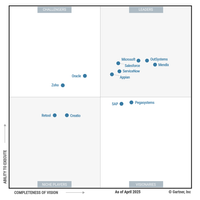
Leaders
Enterprise LCAP Leaders combine exceptional execution with forward-thinking product strategies, offering robust solutions for organizations worldwide. This year’s Leaders include Mendix, OutSystems, Microsoft, Salesforce, ServiceNow, and Appian, who have solidified their positions through significant growth, customer success initiatives, and global expansion.
Challengers
Challenger vendors demonstrate strong execution but lack the visionary approach of the Leaders, particularly in market strategy and product offerings. These vendors are excelling in their core areas and growing their customer base, but haven't yet broadened their reach to diverse buyer needs. This year, HCL Software, Zoho, and Retool join Oracle in the Challengers quadrant, increasing solution diversity and presenting strong competition to the Leaders.
Visionaries
Enterprise LCAP Visionaries, like Pegasystems, Globant (via GeneXus), and Creatio, offer a compelling strategic vision but may face challenges in execution. Smaller, niche vendors with focused use case solutions can also be valuable, particularly if execution history isn't a primary concern.
Niche Players
Enterprise LCAP Niche Players are specialized vendors with a regional or vertical focus. While they may not excel in every area, being recognized in the Magic Quadrant is a notable achievement. Huawei, Kintone, Newgen, and Unqork are examples of Niche Players who excel in specific areas like business process automation, content services, or citizen development, making them ideal for particular use cases.
Source: justlowcode.com© & Gartner® 2026